

Best personalised candles UK: The Definitive Buyer’s Guide
Best personalised candles UK: The Definitive Buyer’s Guide
The best personalised candles combine a meaningful design with a well-made candle that burns safely and releases fragrance evenly. The name, date, photograph or message may make the gift personal, but the wax, wick, vessel and safety testing determine whether it is genuinely good. For most gifts, a container candle with a professionally printed label is the strongest all-round choice. It offers room for a clear personal message without altering the wax or weakening the vessel. It can also carry the safety information that every candle needs. We hand-pour candles in small batches in Nottingham using our own coconut and rapeseed wax blend, with nothing else added to the wax. It is soy-free, paraffin-free, palm-free, beeswax-free and non-GMO. We chose this blend for a slow, clean fragrance release. Our standard 220g candles burn for approximately 45 hours when used correctly, and every fragrance is tested for both cold and hot scent throw. This guide explains how to compare personalised candles in the UK, including the mechanics behind wax, wicks, fragrance, vessels, labels and safe use. It also covers different personalisation methods and the questions to ask before ordering.
The direct answer: what should you look for?
A good personalised candle should have:
- A stable vessel designed to withstand candle heat. – A wax and wick combination tested together. – Clear information about the wax used. – A fragrance that has been tested when cold and while burning. – A label or decoration that does not interfere with the flame. – Legible safety instructions and any required hazard information. – A realistic burn-time estimate linked to a stated candle size. – A design suited to the recipient and occasion. – Packaging that protects both the candle and its personalised finish. – A clear returns policy, especially where custom goods are concerned. The personalised element should improve the gift without compromising the candle. A beautiful photograph cannot rescue an unstable flame, unsuitable container or poorly matched wick. If you want one dependable format, choose a lidded container candle with an exterior personalised label. It is versatile, easy to post and suitable for names, dates, short messages, simple artwork and business branding.
How to choose personalised candles step by step
Personalised candles are bought for many reasons: birthdays, weddings, anniversaries, memorials, housewarmings, new babies, thank-you gifts and business events. The right choice starts with the purpose rather than the artwork.
1.
Decide whether scent or appearance matters most Some personalised candles are primarily decorative. Others are intended to fragrance a room over many evenings. This distinction affects what you should buy. If scent matters, look for a specialist candle maker that explains its wax, wick and fragrance testing. If the photograph or printed message is the main attraction, a gift-printing service may offer more visual options, but you should still check the candle specification. A heavily decorated candle is not automatically a better gift. A restrained label on a well-made scented candle may provide more lasting enjoyment than a complex print on a product with little information about its ingredients or performance.
2.
Match the format to the occasion Container candles work well for most occasions because they are stable, easy to wrap and available with lids. Tins are useful for postal gifts because they are light and less vulnerable to breakage. Glass can feel more formal, but it requires protective packaging. Pillar candles provide a larger decorative surface. However, a design applied directly to the wax must be compatible with burning, and the pillar needs a heat-resistant plate beneath it. Flameless LED candles are appropriate where open flames are not allowed. They provide light and display space but do not behave like scented wax candles.
3.
Check the product beneath the personalisation Ask or look for the following information:
- What wax is used? – Is the candle scented or unscented? – What is its net wax weight? – What burn time is claimed for that size? – What wick material is used? – Has the finished candle been burn-tested? – Is the container designed for candles? – Are safety instructions supplied? – Where is the personalisation placed? – Will the buyer receive a proof before production? If the seller gives detailed design options but almost no candle information, the product may be led more by printing than candle craft. That is not necessarily unsuitable, but it should inform your expectations.
4.
Keep the message readable Short messages usually work better than paragraphs. A name, date and one concise line can remain legible from normal viewing distance. Long wording forces the type to become small and can make the label feel crowded. Check spelling, punctuation and dates carefully. Personalised goods are often made from the text supplied by the customer, so an unnoticed error may be reproduced exactly.
5.
Read the returns terms before ordering Custom-made items may be treated differently from standard products, especially when the item has been produced to an approved design. Check the seller’s cancellation, damage and error policies before placing the order. Mattys Candles accepts returns within 14 days under our published refund policy. Review the terms before ordering so you understand how returns are handled.
The main types of personalised candles
The words “personalised candle” cover several different products. Understanding the production method helps you compare appearance, durability and practical use.
Personalised label candles
A custom label is applied to the outside of a tin, jar or box. It may include names, dates, a message, artwork or a simple photograph. This is usually the most practical approach because the printed material remains outside the wax and away from the wick. Labels also allow the maker to preserve necessary safety and product information elsewhere on the vessel or packaging. Advantages include:
- Flexible typography and colour choices. – Good readability. – Straightforward small-order production. – Compatibility with tins and glass jars. – Space for event details or business branding. – Easier replacement if a label is damaged before dispatch. The label should adhere properly and remain clear during normal use. It should not cover essential warnings or extend into an area where it could be exposed to flame.
Photo candles
Photo candles reproduce a portrait, pet picture, wedding image or family photograph. They are often chosen for milestone birthdays, anniversaries and memorial gifts. Image quality depends heavily on the original file. A dark, blurred or compressed image will not become sharp simply because it is printed on a candle. Cropping also matters: portrait photographs may need adjustment to fit a wide label or curved jar. Before approving a photo candle, check:
- Whether a digital proof is provided. – How much of the image will be cropped. – Whether text will cover faces or important details. – How the image joins at the back of the vessel. – Whether colours may appear different in print. – Whether the photograph is printed on a removable label, a wrap or the wax itself. Photo personalisation is visually strong, but the candle’s specification still matters. Check the wax, wick, scent and safety information just as carefully as you would for a plain candle.
Engraved candle vessels
Laser engraving can place a name, date, monogram or logo on a suitable vessel or lid. It creates an understated finish and may leave a keepsake after the wax has been used. Engraving must be performed on a component that is appropriate for the process. Altering glass can affect it, so buyers should not assume that any drinking glass or decorative container can safely become an engraved candle vessel. The finished candle still needs to be tested as a complete product. Engraved wooden lids are another option. They provide a personalised surface without changing the glass body. The lid must always be removed before lighting.
Printed or transferred designs on wax
Some pillar candles carry designs directly on the outer wax. This creates a seamless decorative appearance, but it requires more scrutiny than an exterior vessel label. Any material placed on or within the burnable area can potentially interact with the flame or melt pool. Ask whether the candle is intended to be burned and whether the decorated finished product has been tested. Do not assume that a decorative candle is automatically suitable for normal burning. A pillar must also be placed on a stable, heat-resistant holder capable of catching melted wax. Keep the flame away from the printed outer wall and stop using the candle if the flame behaves unexpectedly.
Corporate and event candles
Branded candles can be used for client gifts, launches, staff recognition, hotels, salons, weddings and table settings. These orders may involve repeated logos, event dates or coordinated packaging. For business orders, confirm:
- The minimum order quantity. – Whether a physical or digital proof is included. – The production lead time. – Colour limitations for logos. – Whether individual names can vary within one order. – How the candles are packed. – Whether required labels remain visible. – Who is responsible for checking trademark permissions and artwork. A candle given away by a business still needs appropriate product and safety information. Branding does not replace those requirements.
Flameless personalised candles
LED candles imitate the glow of a flame using batteries and internal lights. They are useful where a naked flame is prohibited or undesirable, and their outer surfaces can carry detailed decorative designs. They should not be confused with wax melts. Wax melts are also flameless when used in an electric warmer, but they release fragrance by warming scented wax. Tealight warmers still involve a live flame and therefore are not fully flame-free as a setup. We make wax melts by mixing approximately 10% fragrance oil into wax, pouring the mixture into rubber moulds and allowing it to set for 24 hours. Melts can feel stronger than candles because fragrance is released quickly when the wax is warmed. Replace a melt when its scent fades. For more detail on this format, read our practitioner’s guide to snap bar wax melts.
Candle wax: what the base material changes
Wax is the fuel that carries the fragrance and supports the wick. Its melting behaviour affects the melt pool, scent release, surface appearance and burn rate. However, wax type alone does not determine quality. The entire candle must work as a system.
Coconut and rapeseed wax
We use our own coconut and rapeseed wax blend, with nothing else added to the wax. It is soy-free, paraffin-free, palm-free, beeswax-free and non-GMO. It is also made without bee-harming pesticides. We selected it for a slow, clean fragrance release. Coconut and rapeseed each contribute to the behaviour of the blend. The precise result also depends on the fragrance, vessel and wick. It would therefore be misleading to claim that every candle made with these waxes performs identically. Our candles have been hand-poured in small batches in Nottingham since 2018. Small-batch production gives us control over fragrance distribution, wax finish and quality checks. Every fragrance is tested for cold scent throw and hot scent throw before it forms part of the range.
Paraffin wax
Paraffin is widely used because it is consistent, accessible and capable of carrying fragrance and colour. We avoid it because of indoor-air-quality concerns. That is our material choice, not proof that every paraffin candle performs badly. Buyers who prefer to avoid petroleum-derived wax should look for an explicit wax statement rather than relying on words such as “natural”, “luxury” or “premium”. Those marketing terms do not identify the actual formula. The UK Health and Safety Executive provides general guidance on indoor air quality and ventilation at work, including the importance of controlling indoor pollutants and maintaining ventilation.
Soy wax
Soy wax is common in container candles and is often promoted as a plant-based option. Its performance varies according to formulation, wick choice and fragrance. Surface changes such as frosting do not necessarily mean the candle is unsafe, but they can affect appearance. We do not use soy. Buyers with a preference or sensitivity should seek a direct ingredient statement, because broad descriptions such as “vegetable wax” may not identify every component.
Beeswax
Beeswax has a distinctive natural colour and aroma. It is used in pillars, tapers and some container blends. It is not vegan, and its own scent can influence how an added fragrance is perceived. Our wax is beeswax-free. People choosing personalised candles for vegan recipients should verify the wax, fragrance and any decorative coatings rather than assuming that a candle is vegan from appearance alone.
Palm wax
Palm-derived candle materials can create crystalline finishes and firm structures. Buyers who avoid palm should look for a clear palm-free statement. Our coconut and rapeseed blend is palm-free.
Why wax labels need precise wording
A candle described as “coconut wax” may be a blend rather than pure coconut wax. The same applies to soy and other plant waxes. Blending is not automatically a weakness; it can be necessary to achieve a stable candle. What matters is whether the seller explains the formulation honestly and whether the finished product has been tested. For a broader discussion of value, burn experience and fragrance, see are scented candles worth buying.
Wick mechanics: why a small component matters
The wick regulates how fuel moves from the melt pool to the flame. Its size and construction must suit the wax, fragrance, colour, container diameter and intended burn conditions. A wick that is too small may produce a weak flame and a narrow melt pool. This can leave wax around the edge of the container. A wick that is too large may produce an oversized flame, excessive heat or rapid fuel consumption. Visible smoke or persistent mushrooming can also indicate that the candle needs attention or that the wick and formula are poorly matched. Our wicks are zinc-free and lead-free. This fact describes their materials; safe performance still depends on correct use and testing within the complete candle.
What burn testing examines
A responsible maker should assess the finished candle across repeated burns rather than lighting it once. Relevant observations include:
- Flame behaviour. – Melt-pool development. – Container temperature. – Wick stability. – Soot or smoke. – Scent release while burning. – The amount of wax left near the end. – Changes as the flame moves deeper into the vessel. The fragrance can alter the way a formula burns, which is why changing scent is not merely a cosmetic decision. A combination that works with one fragrance may need different wick testing with another.
Candle care still affects performance
Even a correctly designed candle can behave poorly when placed in a draught or burned without following its instructions. Keep it on a stable, heat-resistant surface and away from curtains, shelves, children and animals. Never leave it unattended. The UK Government’s fire-safety guidance advises keeping candles away from materials that can catch fire, using suitable holders and extinguishing candles before leaving a room. Follow the maker’s wick-trimming and maximum-burn instructions. Do not improvise if the label gives different directions from general internet advice; the product-specific instructions should reflect the candle as tested.
Fragrance: cold throw, hot throw and personal taste
Cold scent throw is the fragrance detected when a candle is unlit. Hot scent throw is the fragrance released while the candle burns. A strong cold smell does not guarantee good performance once the wax is warm. We test every fragrance for both cold and hot scent throw. This matters because the wax, wick and fragrance have to work together. A balanced candle should release a noticeable scent without requiring an unstable flame or an overloaded formula.
Stronger is not always better
Fragrance preference is personal. One recipient may enjoy a bold scent, while another may prefer something soft. Room size, airflow and sensitivity also shape the experience. For small bedrooms, offices or bathrooms, a lighter profile may be more comfortable. Larger living spaces may suit a more noticeable fragrance, but no candle should be expected to overpower a whole open-plan home under every condition. Personalised candles intended for dining tables may be better unscented or lightly scented so they do not compete with food. Memorial gifts may call for a calm, familiar fragrance. Corporate gifts usually benefit from broadly accessible scent profiles rather than highly unusual blends.
Fragrance and pets
Animals have much more sensitive noses than people. We are not vets, so anyone concerned about a particular pet or fragrance should consult their vet. Our view as makers is that forcing a strong scent on an animal unnecessarily is not a kind choice. Provide ventilation, give animals the freedom to leave the room and stop using the product if there is any concern. Never position a candle where a pet can knock it over or contact hot wax.
Candles compared with wax melts
Wax melts can feel stronger than candles because fragrance releases quickly when warmed. They are used in a suitable electric or tealight warmer. Do not overfill the dish, never add water, never leave the warmer unattended and allow the wax to cool before changing it. A melt does not disappear at the same rate as a burning candle because the wax is warmed rather than consumed by a wick. Replace it once the fragrance has faded.
Burn time: how to interpret the number
Burn time is an estimate, not a guarantee that applies under every condition. Candle size, wick behaviour, room airflow and the length of each burn can affect the result. Our standard 220g candles burn for approximately 45 hours when used correctly. That figure applies to that stated size and should not be transferred to smaller or larger candles. When comparing products, check whether the listed weight is the wax weight or the total packaged weight. A heavy glass jar can make a product feel substantial without increasing the amount of burnable wax. Also check whether the seller uses words such as “approximately” or “up to”. An unexplained headline number is less useful than a realistic estimate tied to a specific candle weight and proper use.
Why very short burns can cause problems
If a container candle is repeatedly extinguished before the melt pool develops as intended, wax may remain around the sides. This is often called tunnelling. However, it is not sensible to apply one universal minimum burn duration to every candle. Follow the instructions supplied with the product.
Why very long burns can cause problems
Leaving a candle burning beyond its stated limit can increase vessel heat and change wick behaviour. Extinguish it within the maker’s maximum burn time, let it cool and check the wick before relighting. Never move a candle while the wax is liquid or the container is hot. Stop using it at the point stated by the maker rather than trying to burn every last trace of wax.
Vessel quality and personalisation placement
A candle vessel is part of the safety system. It must cope with repeated heating and cooling under the conditions for which the candle was designed. Decorative drinking glasses, reclaimed jars and ornamental ceramics should not automatically be treated as candle containers. A vessel can look robust while still being unsuitable for direct candle heat.
Glass jars
Glass offers a clear, premium appearance and a smooth surface for labels. Amber or coloured glass can complement certain gift styles. The drawback is breakability, so postal packaging should protect the base, rim and sides. Inspect a new glass candle before lighting. Do not use it if the vessel is cracked, chipped or damaged in transit.
Metal tins
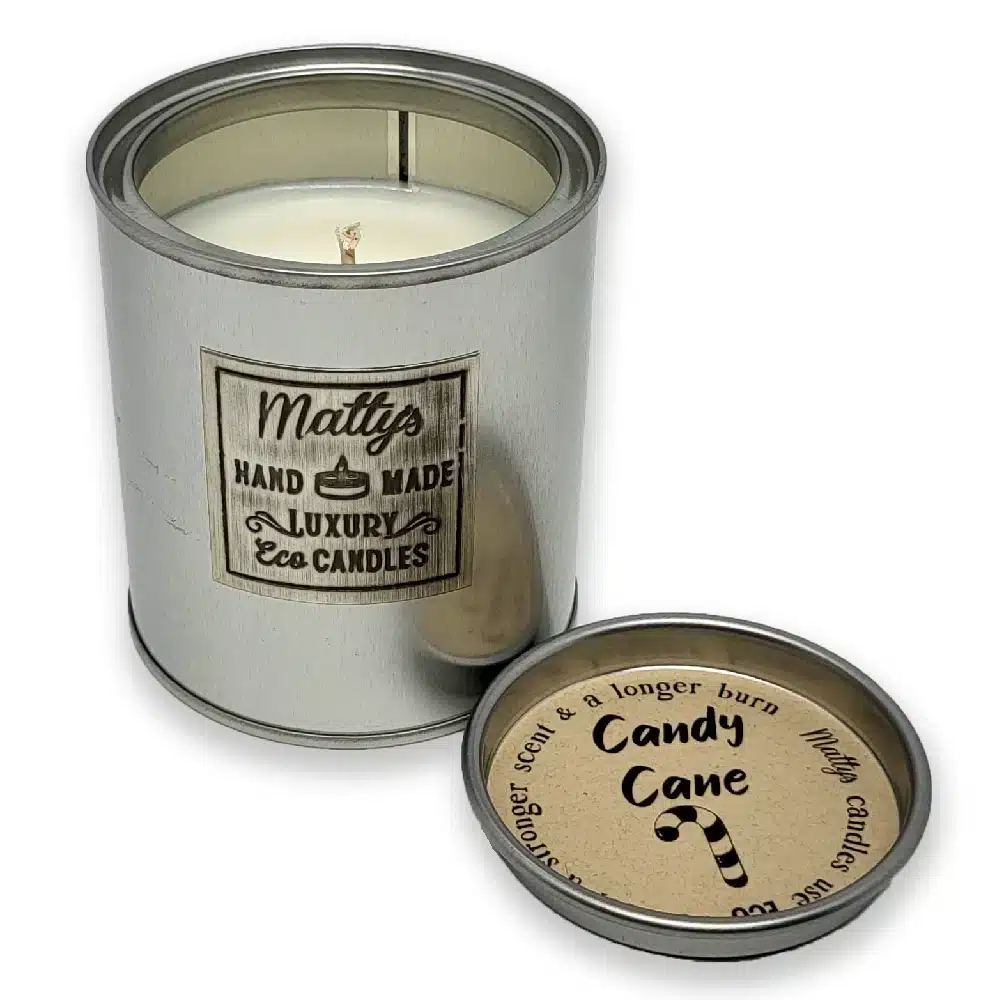
Tins are light and resistant to shattering. They are practical for letterbox-style gifts, travel and event favours. However, metal can become hot during use, so the candle still needs a heat-resistant surface and careful handling. Tin lids provide a useful area for a personalised sticker or label. The lid must be removed before the candle is lit.
Ceramic vessels
Ceramic can create a substantial keepsake and may suit engraved or printed designs. The glaze, wall thickness and shape all matter. Only use a product sold and tested as a candle, and do not assume the empty vessel is food-safe unless the maker specifically says so.
Where the design should go
The safest personalisation methods keep decorative material away from the wick and flame. Common options include:
- An exterior jar label. – A label on a metal tin. – A printed gift box or sleeve. – An engraved lid. – A swing tag attached for presentation and removed before use. – A message card packed with the candle. Avoid loose decorations near the opening. Dried flowers, ribbons, crystals and paper placed on top of a candle can enter the melt pool or come close to the flame. A decorative object is not made safe merely because it appears in a candle photograph.
UK candle safety and labelling
Personalisation does not remove a seller’s responsibility to supply a safe product. The candle must remain suitable for its intended use after the custom design has been applied. In Great Britain, product safety is governed by the applicable consumer product framework. The UK Government’s product-safety guidance explains the responsibilities of producers and distributors, including supplying safe products and providing relevant warnings. Candle-specific British and European standards commonly used by the industry include:
- BS EN 15493, covering fire-safety specifications for candles. – BS EN 15494, covering product safety labels for candles. – BS EN 15426, covering soot behaviour. Standards can be updated, so makers should check the current versions rather than relying on an old article or label template. The British Standards Institution provides the official catalogue and status information for standards.
Safety labels should remain visible
A personalised front label should not remove or obscure the candle’s warnings. Safety information may appear on a base label, rear label, packaging or supplied instructions, depending on the product design and applicable requirements. Typical candle precautions include:
- Never leave a burning candle unattended. – Keep it away from children and pets. – Keep it away from flammable objects. – Use it on a stable, heat-resistant surface. – Keep candles far enough apart. – Follow the maker’s wick and burn-time instructions. Icons should not be used as decoration without understanding what they mean. The final label needs to match the actual product.
Fragrance hazard information
Fragranced products may require classification and labelling based on their finished composition. The relevant requirements depend on the substances and concentrations present, not simply on whether the fragrance smells mild or natural. The Health and Safety Executive explains Great Britain’s chemical classification, labelling and packaging framework and the duties associated with hazardous mixtures. Makers should use formulation-specific information rather than copying a generic warning from another candle. A personalised message must never replace required hazard wording. If space is limited, the design should be changed rather than making mandatory information unreadably small.
What safety wording cannot prove
Terms such as “clean”, “eco”, “non-toxic” and “natural” can be vague unless the seller explains precisely what they refer to. A natural fragrance can still contain substances that require disclosure, while a synthetic fragrance is not automatically unsafe when properly formulated and used. Look for specific, verifiable statements. Wax composition, wick material, candle weight, approximate burn time and clear usage instructions are more informative than broad lifestyle claims.
Personalised candles for different occasions
The strongest design feels appropriate to both the event and the recipient. The same layout will not suit every occasion.
Birthdays
Include the recipient’s name, age if appropriate and a short message. Choose a scent they are likely to use rather than one selected only to match the label colour. If you do not know their fragrance preferences, understated profiles or an unscented candle may be safer than an intense or unusual aroma.
Weddings
Personalised candles can serve as favours, table decorations, gifts for the wedding party or keepsakes for the couple. Useful details include names, the wedding date and a brief thank-you. For candles lit at the venue, confirm the venue’s flame policy first. Some locations permit enclosed candles but not exposed flames; others prohibit candles completely. LED alternatives may be required.
Anniversaries
Dates, initials and locations work well for anniversary designs. An engraved lid or restrained vessel label can create a keepsake without overcrowding the candle.
Memorials
Memorial candles should be designed with particular care. Confirm the spelling of the person’s name and all dates before production. A simple photograph and quiet wording are often more effective than decorative clutter. The recipient may want to display the candle without burning it, so a clear front-facing design can be important. If it is intended for use at a service or venue, check local flame rules.
Housewarmings
A house name, moving date or short welcome message can make a practical home gift feel considered. Neutral vessel colours are easier to place in an unfamiliar interior. A candle can also form part of a larger present. For ideas on combining fragrance products, read our guide to home fragrance gift sets UK.
Corporate gifts
Keep business designs clear and restrained. A large logo covering every visible surface can make the gift feel like an advert. A smaller mark paired with a useful fragrance and a personal note often feels more thoughtful. Check that the supplier has permission to reproduce the artwork and that the logo file is suitable for print. Vector artwork is commonly preferable for crisp lines, though the seller should specify the accepted format.
How to judge quality from an online product page
You cannot smell or burn a candle through a screen, so the product page must provide enough detail to support a sensible choice.
Positive signs
Look for:
- A specific wax description. – The net wax weight. – An approximate burn time for that size. – Wick information. – Clear vessel dimensions. – Complete safety instructions. – A description of the personalisation method. – Proofing and artwork guidance. – A visible returns or refund policy. – Realistic photographs from several angles. A maker who explains limitations is often more useful than one promising that every design, photograph and scent will work perfectly.
Warning signs
Be cautious if:
- The wax is described only as “premium”. – The product weight includes packaging but this is not clear. – There are no safety instructions. – Decorative material appears close to the wick. – The vessel looks improvised. – Extraordinary burn times are given without a candle size. – The seller promises an exact scent experience for every room. – The personalisation obscures warnings. – The listing provides no process for correcting artwork errors. One missing detail does not prove a candle is poor. It does mean you may need to ask before buying.
Price and value: what are you paying for?
The price of a personalised candle can reflect several separate costs:
- Candle ingredients. – Vessel and lid. – Fragrance development and testing. – Small-batch labour. – Artwork setup. – Individual printing or engraving. – Proofing. – Gift packaging. – Protective postage materials. – Low-volume production. A low-priced candle may suit a large event where visual consistency matters most. A hand-poured candle may be more appropriate for a close relative or client when scent and finish matter as much as the design. Do not compare prices without comparing candle size and specification. A larger-looking vessel may contain less wax than expected, while a compact jar can have a substantial fill. Net wax weight provides a more useful comparison than outside dimensions alone. Value also depends on whether the recipient will use it. A carefully chosen scent and readable message are usually worth more than an elaborate design that does not suit their home.
How our small-batch process works
We have hand-poured in Nottingham since 2018. Small-batch production allows control over fragrance distribution, wax finish and quality checks. Our process is grounded in the product facts that matter to the finished candle:
- We use our own coconut and rapeseed wax blend, with nothing else added to the wax. 2. The blend is soy-free, paraffin-free, palm-free, beeswax-free and non-GMO. 3. We use zinc-free and lead-free wicks. 4. Every fragrance is tested for cold and hot scent throw. 5. Standard 220g candles burn for approximately 45 hours when used correctly. 6. Finished candles are checked in small batches before they leave us. Small-batch production does not make a candle automatically superior. Its practical advantage is control. It allows closer attention to fragrance distribution, wax finish and quality checks than a purely decorative description would reveal. For more help comparing specialist scented candles, read which UK brand makes the best scented candles.
Candle care after the gift is opened
A personalised candle needs the same careful use as any other candle. The printed name or photograph does not change the basic fire precautions.
Before lighting
- Read the supplied instructions. – Remove the lid and all outer packaging. – Remove ribbons, tags or loose decorations. – Check the vessel for chips or cracks. – Put the candle on a stable, heat-resistant surface. – Keep it away from draughts, children, pets and flammable materials. – Prepare the wick as directed by the maker.
While burning
- Never leave the candle unattended. – Keep it within sight. – Do not move it while the wax is liquid. – Do not allow debris to enter the melt pool. – Extinguish it if the flame becomes unusually large or unstable. – Follow the stated maximum burn time.
After extinguishing
Allow the wax and vessel to cool fully. Check the wick before the next use and keep the candle free of dust or debris. Replace the lid only once the candle is cool. Stop using the candle at the maker’s stated endpoint. Continuing until the flame reaches the base can overheat the container.
Common mistakes when ordering personalised candles
Choosing by design alone
A striking label can distract from missing information about the wax, weight, wick and burn time. Check the candle specification before spending time perfecting the artwork.

Supplying too much text
Long poems and messages can become difficult to read on a small jar. Put the central words on the candle and add a separate card for longer sentiments.
Uploading a low-quality image
Use the original photo where possible, not a screenshot from social media. Check focus, lighting and crop before submission.
Ignoring the proof
If a seller provides a proof, examine every word and number. Check names, dates, line breaks, image position and capitalisation. Do not approve it until it is correct.
Assuming every personalisation method is burn-safe
A material that looks attractive may not belong near a flame. Ask whether the decorated finished candle is intended and tested for burning.
Forgetting delivery risk
Glass needs protective packaging, while tins may dent if loosely packed. If the gift is being sent directly to the recipient, confirm whether invoices are omitted and whether a gift message can be included.
Ordering too late
Personalised products require artwork review and production before dispatch. Use the supplier’s current timescale rather than assuming that a custom item can ship as quickly as an off-the-shelf candle.
A practical comparison checklist
Use this checklist before buying personalised candles online:
Candle construction
- Is the wax type stated clearly? – Is the wick material identified? – Is the net wax weight shown? – Is the burn time linked to that weight? – Is the vessel made for candle use? – Has the fragrance been tested hot and cold?
Personalisation
- Can you preview the design? – Are image requirements explained? – Is the text large enough to read? – Does the decoration remain away from the flame? – Can required safety information still be seen? – Who is responsible for checking spelling and dates?
Ordering
- Is the production timescale stated? – Is there a minimum quantity? – Is protective packaging included? – Can a gift note be added? – What happens if the item arrives damaged? – What does the returns policy say about personalised goods?
Safe use
- Are instructions supplied? – Is a maximum burn duration given? – Is there guidance on the final amount of wax? – Are standard candle warning symbols present where needed? – Is fragrance hazard information supplied where applicable?
Are personalised candles environmentally responsible?
There is no single environmental label that settles this question. A candle has several components: wax, fragrance, wick, vessel, label, lid, packaging and transport. Each contributes to its overall impact. More useful questions include:
- Is the wax composition disclosed? – Is the vessel durable and appropriately sized? – Is packaging proportionate and recyclable where local facilities permit? – Is the candle made in quantities that reduce waste? – Can the vessel be reused safely after proper cleaning? – Are environmental claims precise rather than vague? We use a coconut and rapeseed blend that is paraffin-free, soy-free, palm-free, beeswax-free and non-GMO. These are specific formulation facts. They should not be inflated into a claim that the product has no environmental impact. Reusing a vessel can extend its useful life, but it must be cleaned properly. Do not use a former candle jar for food unless the supplier confirms it is suitable for that purpose. Never place a new wick and wax into an old container unless you have the knowledge and testing needed to make a safe candle.
The final verdict
The best personalised candles are not simply ordinary candles with names printed on them. They are complete products in which the personalisation, wax, wick, fragrance, vessel and safety information all work together. For the most dependable gift format, choose a candle container with an exterior custom label or an appropriately personalised lid. Check the net wax weight, approximate burn time, wax composition, wick information, testing details and safety instructions. Keep decorative materials away from the flame, and do not let a photograph or message obscure essential warnings. Our own approach is to hand-pour in small batches in Nottingham using a coconut and rapeseed wax blend with nothing else added to the wax. We test every fragrance for cold and hot scent throw. Our standard 220g candles provide approximately 45 hours of burn time when used correctly, and our wicks are zinc-free and lead-free. Ready to choose a thoughtful home-fragrance gift? Explore our guide to home fragrance gift sets UK, compare the wax, size and scent, then select the option that best suits the recipient. Before ordering, read our refund policy and check every personalised name, date and message carefully.
Frequently asked questions
What are the best personalised candles for gifts?
Container candles with professionally printed exterior labels are a dependable choice for most gifts. They provide space for names, dates and short messages while keeping decorative material away from the wick. Check the wax, net weight, burn time, vessel and safety instructions as well as the design.
How long do personalised candles burn?
Burn time depends on wax weight, wick, vessel and correct use. The personalisation itself should not change burn time if it remains outside the burn area. Our standard 220g candles burn for approximately 45 hours when used correctly.
Can a photograph be put on a candle?
Yes. A photograph can be printed on a vessel label, full wrap, box or suitable decorative surface. A label on the outside of a container is generally the most straightforward format. Use a clear, high-resolution image and review the crop before approving production.
Are personalised candles safe to burn?
They can be safe when the finished product is properly designed, tested and labelled. Personalisation must not place combustible decorations near the wick, damage the vessel or cover necessary warnings. Follow the product-specific instructions and never leave a burning candle unattended.
Which wax is best for a personalised candle?
No wax is best in isolation. Performance depends on the complete formula, wick, fragrance and vessel. We use our own coconut and rapeseed wax blend, with nothing else added to the wax, because we chose it for a slow, clean fragrance release.
Are personalised candles suitable for weddings?
Yes. They can be favours, table decorations or gifts for the wedding party. Confirm the venue’s flame rules before planning to light them. Keep wording concise, check all dates and ensure safety labels remain present.
Can personalised candles be returned?
Returns depend on the seller’s terms and whether the product was made to an approved custom design. Read the policy before ordering. Mattys Candles accepts returns within 14 days under our refund policy.
Are candle tins better than glass jars for posting?
Tins are lighter and do not shatter, making them practical for postal gifts. Glass can provide a more formal appearance but needs stronger protective packaging. Both can work well when the finished candle is properly made and packed.
Can personalised candle jars be reused?
Many vessels can be repurposed after the candle has finished and the residue has been safely removed. Follow the maker’s cleaning guidance. Do not assume a candle jar is food-safe, and do not refill it as a candle without appropriate expertise and testing.
What should I write on a personalised candle?
Use a name, meaningful date and one short line. Examples include a brief birthday greeting, wedding date, house name or simple memorial wording. Longer messages are usually clearer on an accompanying card.
Sources
- UK Health and Safety Executive, “Ventilation in the workplace”: https://www.hse.gov.uk/ventilation/ UK Government, “Fire safety in the home”: https://www.gov.uk/government/publications/fire-safety-in-the-home UK Government, “Product safety advice for businesses”: https://www.gov.uk/guidance/product-safety-advice-for-businesses British Standards Institution, standards catalogue and guidance: https://www.bsigroup.com/en-GB/standards/ UK Health and Safety Executive, “GB classification and labelling”: https://www.hse.gov.uk/chemical-classification/index.htm